
Was Judas Controlled Opposition?
On the weirdness of Gnosticism, and what your spiritual beliefs reveal about your psychology

"But you will exceed all of them. For you will sacrifice the man that clothes me."
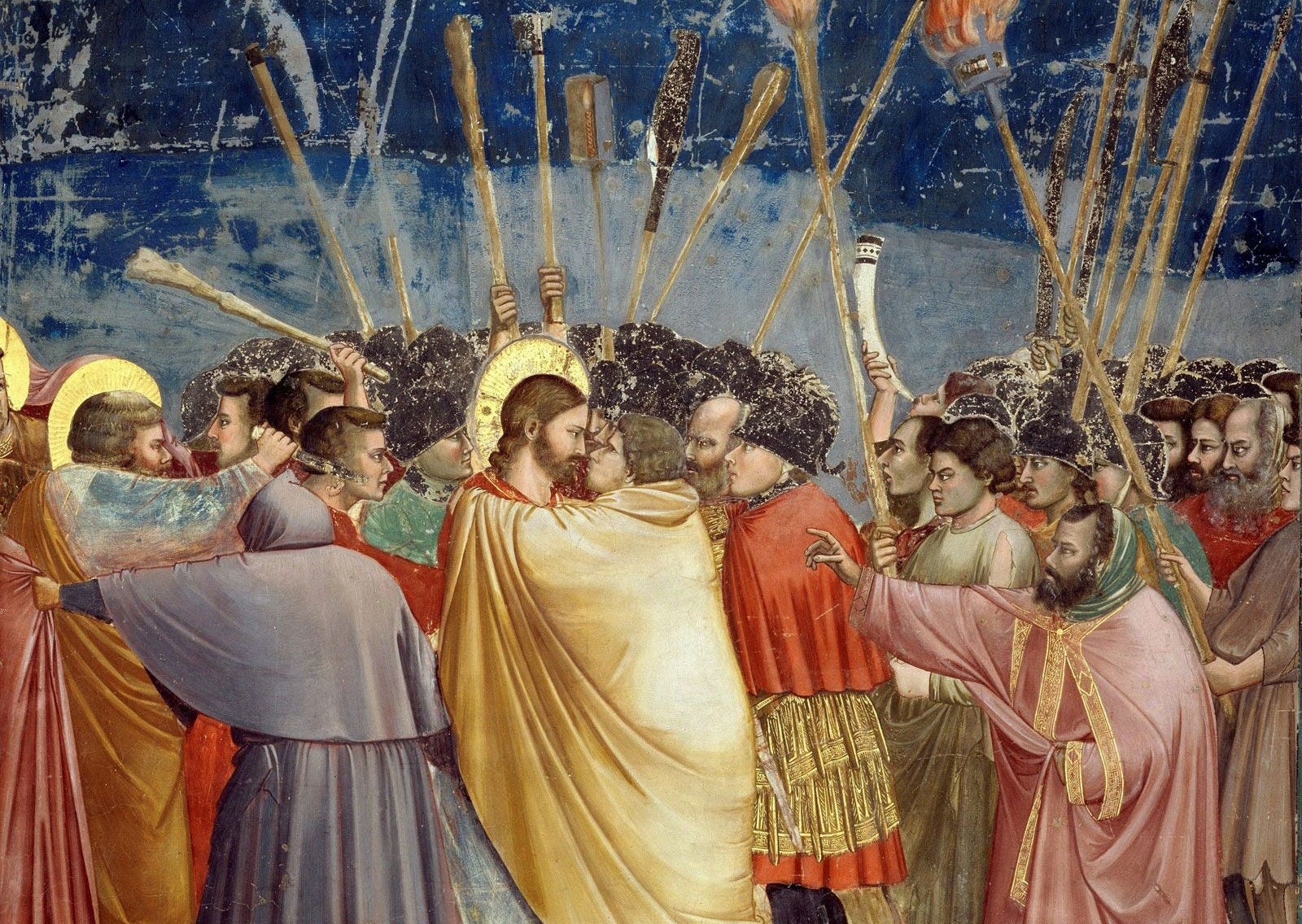
According to the Gospel of Judas - a lost Gnostic text found in the mid 20th century, these are the words Jesus spoke to his betrayer - Judas Iscariot.
Needless to say, this is a pretty shocking plot twist in the Christian cannon. It takes one who is perhaps the most vilified figure in all of Christianity, and makes him into Jesus’ most trusted disciple.
Even Dante's Inferno positions Judas as literally the worst person ever. In the innermost zone of the ninth and final circle of hell, Judas is pictured headfirst in the central mouth of Lucifer himself, where he is crushed and gnawed for eternity within the mouth of the devil. This positions him pretty clearly as the 'worst guy ever', and reflects Dante's views on the nigh-unforgivable nature of betrayal within the Christian worldview.
The Gospel of Judas, then, recharacterizes this 'Great Betrayer' as the most trusted disciple of Jesus - one entrusted with his secret teachings.
The text itself is quite short, but it's strange cosmogony makes it incredibly confusing, to the extent that religious and secular scholars regularly engage in debates over what the text actually means.
The brunt of the text takes place over the course of the few days before the Last Supper and Jesus' betrayal. The 'secret teachings' portion of the text involve a set of convoluted revelations on the nature of the cosmos, the transcendent God of Gnosticism, and enumerations concerning the creation of celestial beings as well as mankind.
In the opening scene, Jesus seems to be mocking his disciples for praying over their bread. Ostensibly, since this is an action of reverence to the illusory, material realm, Jesus mocks them, and even laughs1. When they grow frustrated and question Jesus, he answers that, "you're not doing this because you want to, but because through this -your God [will be] praised." They get confused and declare that Jesus is, in fact, the son of their God, and then Jesus proceeds to break their brains by asking them "how do you know me?"
The followers grow increasingly frustrated until Jesus challenges them, urging that if any of them were "[strong enough] among humans to bring out the perfect Humanity," to stand and face him. The disciples are all bark and no bite, as they remain seated while bitching about how they're strong enough. Judas, however, is the only to follow suit. He stands, unable to look Jesus in the eyes, and drops the weirdest line ever:
"I know who you are and where you've come from. You've come from the immortal realm of Barbelo, and I'm not worthy to utter the name of the one who's sent you."
Huh??
This part is a dead-ringer for Gnostic cosmology, and it’s what scholars used to originally identify the text as a Gnostic gospel. It parrots the name of Barbelo - the being which stands amongst he first two emanations of the true God of the Gnostics.
The rest of the gospel involves a few more conversations amongst the disciples, and the secret teachings from Jesus to Judas, in which Jesus explicates the remainder of the Gnostic mythos, including details about the creation of the material realm by the demiurge - an misbegotten creation of the Gnostic emanation of wisdom - Sophia.
Finally, when all of this secrets are revealed, Judas approaches the Jewish high priests and sells Jesus out for 30 silver pieces, just as planned.
Alternate History
Obviously, I have no idea if anything in the Gospel of Judas actually happened. More likely, it's a text explicitly written to lend credence to the Gnostic worldview by lending it some of that good ol' social proof from the big man himself. However, it still reframes much of the Christian worldview in an extremely interesting way, and provides a re-interpretation for the motivations behind Judas' betrayal that seem to make more sense.
Interestingly, had history taken a slightly different course, modern Christianity might have been much more Gnostic than it is today. Tertullian, a prominent church father in the 2nd century AD, mentioned in his writings that Valentinus was an very serious contender for the seat of the Bishop of Rome (the original name for the Pope). Valentinus was a prominent Gnostic theologian, and the founder of Valentinianism.
Though his teachings were later decried as heretical, as Gnosticism began to pale in comparison to the growth of Catholicism, Tertullian's accounts go to show just how prominent Gnostic teachings were in early Christianity. Had a version of Christianity taken prominence which implicated the god of the Old Testament as evil (or at least incompetent), how might our world look today?
What Our Beliefs Say About Us
All of this had me thinking about something I’ve wondered about for years now. That is - how the primary mechanics (metaphysical assumptions) of different belief systems account for the various neuroses which one encounters simply by being a thinking, feeling human being.
For example, what do I do when I realize that some people are born into utter suffering and travesty? Is we grow older in thew age of information, we no longer need to travel the world to realize there's a whole lot of terrible stuff going on. Often times, we can simply push these things outside of our conscience.
If John jumps in a lake infested by crocodiles, and proceeds to be ripped apart, I can rest easy knowing that John is dumb idiot, and that's all one can reasonably expect if they jump into crocodile-infested waters. But that's too easy. When I hear about a child in a war-torn country killed or brutally crippled for simply existing in a place where conflict occurs completely outside of their control, I can't call that child a dumb idiot. I have to invent a new conception of the world that accounts for this newly-discovered element of the arbitrary nature of suffering in such a way that allows me to sleep at night. Or I could choose to try to help those people. But why would I do that?
If I believe in rebirth and reincarnation, I can find that desired sense of comfort under the mechanics of karmic reincarnation. I must have lived a good life in my last incarnation, and I'm enjoying the fruits of my labor by sitting at my computer, drinking tea, eating scrambled eggs, and confusedly straw-manning religion to a group equally confused people on the internet. How about the 200 million egg-hens squished together in battery cages for the entirety of their miserable existences? Well, they must have been really bad in their past lives, so I can rest easy knowing that all suffering is deserved suffering.
If I believe in heaven or hell, then I can rest easy knowing that maybe good things don't happen here on Earth, but it'll all come out in the wash somewhere high above (or deep below). As long as I act like a good person and repent for all of my evil deeds, I'll be rewarded with eternal salvation in a realm of pure bliss. And, if I choose otherwise, my immortal soul will be damned to hell where I'll be tortured forever, having had only a single chance to live a good life. Well, that one checks off all the inadvertent and undeserved child casualties of war, since I guess they'll all go to heaven. And the chickens? Welp, they have no souls, so they don't matter anyway. They are merely facsimiles of intelligent beings created as a non-perishable organic resource for humanity. Well, that settles that.
Wait, do dogs have souls? Oh fuck wait I hope dogs have souls. And cats? I've never really been a cat person but they seem pretty smart and my friends love their cats. Shit.
Ok maybe Gnosticism, then?
To the Gnostic, the existence of suffering comes to be evidence of the illusory nature of the material realm. Well, that answers one question by throwing it way down the field. Then what about salvation? From what I can tell, Gnosis seems to be an idealized end-state of realization which can be achieved both in life and death, so I guess that confirms salvation for all? There isn’t a definitive stance on animals, or on pretty much anything since Gnosticism is split amongst thousands of smaller groups, and doesn’t have an official, centralized dogma.
I give up.
Wrapping It Up
There is one thing I’ve noticed to be almost universally true when it comes to spirituality and the religious impulse. No I'm not going to go on an atheistic rant about how all religions are malicious instruments of human control because that is an objectively myopic characterization. Yes, some people use religion and spirituality as a tool to act upon their worst instincts, but that is neither here nor there - people do this with everything.
The truth lies in comfort. Not the escapist kind you get from smoking weed and sitting on the couch, but the existential kind that allows you to look at a sunrise - something that occurs unfailingly every single morning - and be subtly reminded that no matter now bad things get, everything we be fine. Stress is the source of pretty much everything that kills us from within. It's powerfully linked to cancer formation, depression, sedentarism, dementia and Alzheimer's. At its most fundamental level, spirituality aims to ameliorate stress by providing Telos - a grand, universal purpose which implicates not only one's individual life, but everyone and everything else that has ever existed and will ever exist.
But maybe allowing yourself to be force-fed spiritual knowledge in such a way that keeps you happy and full and unchallenged isn't the way to go. Half of the purpose seems to be in actually pursuing Truth. And that seems to lie squarely in experience. Knowledge gives you a bunch of quotes you can regurgitate when you think the need arises - wisdom is the peace of mind to notice how rarely that need actually arises.
I want to make it quite clear that I'm young and I have a very long way to go with all of this, but in the absence of a rigid spiritual system life can feel a lot more uncertain. It's a welcome feeling at times, but at others it can feel quite isolating. So, I figured I'd end off this disjointed and tangential piece with a few snippets of wisdom I've picked up from others a lot older and wiser than myself. Life kind of sucks when you don’t believe in anything, so at the very least having a few little ‘anchors’ you can return to in the absence of a filled-out belief system seems to help a lot.
Feel free to propose additions to this in the comments. I might edit them in if they are cool
If you find yourself using a holy text to confirm something you already believe, you might be doing it all wrong. There's an argument to be made that confirmation bias is just a self-satisfying form of idolatry. Most texts are large enough that you can use them to justify nearly anything - that’s not an invitation to do so.
If a higher power exists, it speaks in the silence.
I don't believe in Truth because I know that it is something real, I believe because it animates me irrespective of its reality. In some sense that seems to make it real (basically, the concept of faith seems to have an reality independent of our own).
The claim amongst new age spirituality schlop that Buddha and Jesus taught the same things collapses under the weight of any degree of serious research into their respective teachings (this goes for most schools of religious thought). It's fine to subscribe to the beliefs of multiple spiritual systems simultaneously, but using 'same difference' as a way of taking any nuance out of comparative theology is an easy road to the kind of Kumbaya spiritual reductionism that takes this piss out of depth of the teachings of people who were probably a lot older and wiser than you.
Really looking forward to the comments on this one. I'm interested to hear from those of a variety of faiths as to the 'psychological profile' of their metaphysical beliefs.
Also, I seems that Gnosticism is making a pretty significant comeback in the modern day, and I'm curious about whether or not you guys have noticed this - and what your thoughts are.
Notably, there isn't a single text in the New Testament which explicitly mentions Jesus laughing.
Okay, I made it all the way through, first thought: AMAZING. Second thought: The book "Man's Search For Meaning" By Viktor E Frankl is what the bit about suffering reminded me of, I often find myself, as a Christian (but the kind that is in complete madness), struggling to make sense of the unfair suffering of the world. I also believe in reincarnation, I hate the traditional view of Karma though, hince the madness. Your post is the first substack post I have read with any kind of-- reverence for the unknowable. Like breathing in fresh air. Thank you.
reading now, may TL;DR it if it's too triggering #PTSD #IWishIWasJoking